Experience-Efficient Physical Learning
How robots can learn actionable, physically grounded knowledge from limited continual real-world interaction — and know when another interaction is worth its cost or risk.

Robotics · Physical Learning · Resilient Systems · Robotic Science
Research Associate (Postdoc), Cardiff University
I develop robots that learn efficiently from physical experience, understand and adapt to their own changing capabilities, and operate reliably in scientific and other consequential real-world systems.
Research thesis
How can autonomous robots build reliable knowledge of the physical world, understand their own changing embodiment, and use both safely within human scientific systems?
How robots can learn actionable, physically grounded knowledge from limited continual real-world interaction — and know when another interaction is worth its cost or risk.
How robots can establish operational knowledge of their own embodiment and capabilities, detect change or damage, and adapt while preserving safe operating boundaries.
How robots, models and scientists can conduct auditable physical experiments that remain safe, resilient and scientifically useful when equipment, evidence or conditions deviate from plan.
Across all three directions, I use physically grounded and testable representations rather than treating interpretability as a post-hoc explanation problem: a robot should be able to connect what it believes to physical causes, uncertainty, and actions that can test those beliefs.
I am a research associate in the School of Engineering and the School of Pharmacy and Pharmaceutical Sciences at Cardiff University, and the manager of the Robotics and Autonomous Systems Lab. My research sits at the intersection of physical learning, robot manipulation, system identification, resilient robotics, and autonomous scientific experimentation. I also use 3D and multimodal perception as enabling tools for robots that must reason and act under incomplete physical information.
A recurring theme is that real robots cannot assume unlimited data, perfectly known bodies, or perfectly repeatable environments. I therefore study how robots can extract useful physical knowledge from small amounts of interaction, determine what they can currently do, recognise when those assumptions fail, and gather the evidence needed to adapt safely.
I completed my PhD at Cardiff University in 2023, working on hierarchical reinforcement learning and affordance learning for robotic manipulation. Before that, I received my Bachelor's and Master's degrees in Mechanical and Industrial Engineering from Guangdong University of Technology, China.
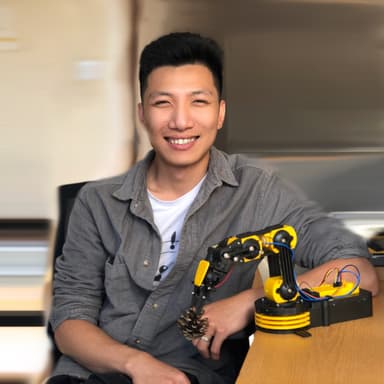
I am a Fellow of the Higher Education Academy (FHEA). In 2023–2024, I taught as a module lecturer on EN3062 Robotics and Image Processing and EN4062 Advanced Robotics at Cardiff University.
I also contribute to robotics lab tours, demonstrations, student development, and public engagement that connects research in robotics and autonomous systems with wider audiences.